
1. UHMWPE vs HMPE: what's the difference?
To understand HMPE slings, start by separating two terms that are often used interchangeably.
UHMWPE (ultra-high molecular weight polyethylene) has a molecular weight in the millions — far higher than ordinary polyethylene. During manufacturing, the fiber is gel-spun and drawn at very high ratios, which orients the polymer chains along the fiber axis. That orientation is what gives it a set of exceptional properties: at equal weight it is roughly 15 times stronger than steel per unit weight; its density is only about 0.97 g/cm³, so it floats and is hydrophobic; and it resists chemical corrosion.
HMPE (high-modulus polyethylene) is the industry term for ropes, slings, and cables made from UHMWPE fiber — the same base polymer, described at two levels: the fiber and the finished sling.
In short: UHMWPE is the fiber; HMPE is the sling you buy. For a closer look at the material itself — density, strength, temperature and light limits — see UHMWPE or HMPE? What Sling Buyers Should Know.
Procurement tip: this high-modulus polyethylene fiber is best known under the trade name Dyneema® which is a trademark of Avient (formerly DSM), but it is not the only source — when buying, focus on the fiber grade and its suitability for your application, not on the brand name.
2. HMPE sling types and construction
HMPE slings are covered by ISO 18264:2022. Two constructions are in common use:
- Eye-and-eye slings — a length of rope with a spliced eye at each end, and eyes can be fitted with thimbles, end fittings, or covers depending on how the sling connects to hooks, shackles, or lifting beams.
- Endless slings — a load-bearing core wound into a loop and enclosed in a woven cover, which often used in basket and choker hitches; the load is distributed evenly, the sling can be turned for even wear, which spreads the wear and extends service life.
Both types share the same construction principle: a load-bearing HMPE core protected by an abrasion-resistant cover (guards against cutting, UV, and salt spray).
Procurement tip: confirm structure, WLL, length, cover, and coding details with your supplier against the owner's lifting plan. For available options, see our HMPE Slings for Heavy Lifting product page (eye & eye and endless configurations, WLL 1 t – 2,000 t; engineered per lift plan).
3. Where HMPE slings fit — and where they don't
HMPE's core advantages can be summed up in five points: high specific strength, corrosion-free, floats, low elongation (accurate positioning), and no "fish-hook" broken-wire injury risk from steel rope fatigue. Typical applications include:
- Offshore wind — monopile, tower, nacelle, and blade lifting, where rigging weight directly affects crane capacity.
- Marine and oil & gas — HMPE is hydrophobic and resists seawater and most industrial chemicals; the cover protects the core from UV.
- Precision positioning — HMPE's low elongation (typically <1% at working loads, and stable once bedded in) suits precise positioning of heavy components.
- Frequent lifting and confined spaces — light enough to rig by hand, saving auxiliary machinery.
For the full picture of offshore applications, see HMPE Slings in Offshore Wind and Marine Engineering.
But HMPE is not a universal answer: ISO 18264:2022 covers general purpose lifting only — it does not cover lifting people, or lifting molten metal, acids, glass sheets, or fissile and nuclear materials. And HMPE has real limits: sustained heavy loads cause slow creep, high temperatures soften the fiber, and sharp edges can cut the core. We cover these limits in detail in HMPE Sling Limitations.
4. The pre-order checklist
HMPE slings are customised safety products, not standard items: two slings both "WLL 30 t, 6 m long" can differ substantially in price and safety margin depending on grade, cover and factory documentation. Before ordering, verify the three points that decide most offshore acceptance outcomes:
| Check item | What to check | Basis / reminder |
|---|---|---|
| 1. WLL and design factor | Breaking strength ≠ working load; WLL = breaking strength ÷ design factor | Required design factors differ by jurisdiction: 7:1 under the EU Machinery Directive (2006/42/EC), 5:1 under ASME B30.9 (US); offshore projects often require higher values per owner specs or class society requirements |
| 2. Material grade | Order the HMPE fiber grade/brand specified in the plan; if not specified, require the supplier to state in writing the grade used and its suitability | Grades differ in creep and fatigue behavior; choose the grade suited to the duty |
| 3. Documentation, marking and batch | Certificate of conformity, CE marking, MTC/MTR, label fields and traceability code; purchase as a complete set and keep batch records | Marking follows ISO 18264:2022 for HMPE; the full six-point checklist is in Precautions for Procuring HMPE Slings |
For the full ordering checklist, see Precautions for Procuring HMPE Slings. For acceptance and in-service inspection, see HMPE Sling Arrival Inspection and In-Service Inspection Checklist. For supplier selection, see Direct Manufacturer vs Trader: HMPE Sling Supplier Due Diligence Checklist.
5. HMPE sling FAQ
What temperature range can HMPE slings handle?
EN 1492-2 rates polyester and polyamide roundslings from -40°C to +100°C, but does not list HMPE as a material. HMPE slings are typically rated for use and storage from -40°C to +70°C. The fiber softens above this range, so keep slings clear of hot pipes, welding arcs, and steam lines.
Do HMPE slings rust or corrode?
No. HMPE is hydrophobic and resists seawater and most industrial chemicals — it does not rust like steel. Avoid strong oxidizers and prolonged exposure to concentrated acids. The cover shields the load-bearing core from UV, so keep the cover intact.
HMPE vs steel wire rope — which should I choose?
HMPE has clear advantages where light weight, corrosion-free, frequent lifting, and floating matter, but in sustained full-load, high-temperature, or unprotected sharp-edge conditions it must be managed per the standard — it is not a universal replacement. If extreme abrasion or very high temperatures are unavoidable, steel wire rope is still the better choice. See our detailed comparison: HMPE Slings vs Steel Wire Rope vs Polyester: How to Choose for Offshore Lifting.
Why are HMPE slings more expensive, yet total cost can be lower?
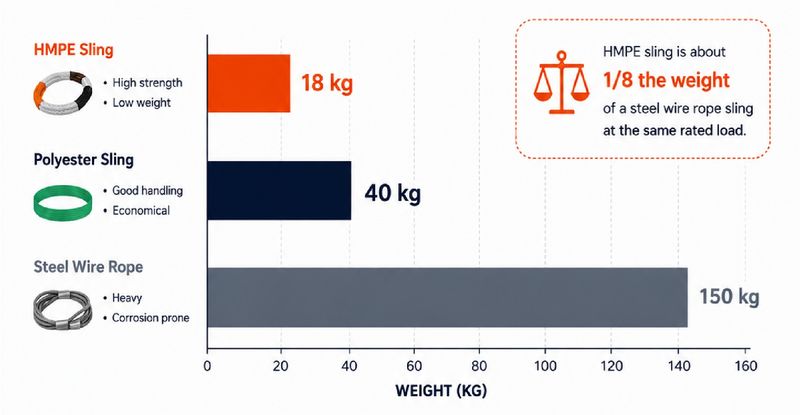
The fiber itself costs more, and the splicing and cover construction are more labor-intensive. But at equivalent working load, a finished sling typically weighs only about one-eighth of steel cable — the savings in auxiliary lifting machinery, manual rigging, anti-corrosion maintenance and transport often outweigh the higher purchase price. In long-term offshore storage and frequent lifting scenarios, whole-life cost is often better than steel cable.
Are HMPE slings suitable for long-term heavy loads?
HMPE creeps slowly under sustained load — the higher the load and temperature, the faster. For long-term or critical loads, specify a low-creep grade and an appropriate design factor, and monitor temperature. Consult the manufacturer to select the right fiber for the intended use.
How do I know when to retire an HMPE sling?
Retire immediately on cover damage exposing the core, fiber fuzzing, stitching cracks or eye deformation, severe cuts/burns/corrosion, chemical or high-temperature damage, irreversible elongation (creep), or overload shock. In short, retire at the first sign of obvious damage; when in doubt, retire: the load is worth more than the sling. For detailed criteria, see the HMPE Sling Arrival Inspection and In-Service Inspection Checklist and the product page FAQ "When to retire".
6. What the research says
Full-scale testing of HMPE slings in offshore lifting operations confirms they are reliable for offshore service, and lighter and safer to handle than steel wire rope[1]. The research also highlights two practical points for buyers: new HMPE slings should be pre-tensioned (bedded in) before first use to stabilize length and stiffness, and creep under sustained load is the main thing to manage through grade selection, design factor, and inspection[2][3].
7. Technical notes
EN 1492-2 lists polyamide, polyester, and polypropylene and does not cover HMPE. The HMPE-specific values in this guide follow ISO 18264:2022.
This guide is for procurement education and does not constitute a lifting design basis; actual parameters follow the rigging plan issued by the owner/EPC.
References
[1] Lian Y. et al., Experimental investigation on service safety and reliability of full-scale HMPE fiber slings for offshore lifting operations. Ocean Engineering 285 (2023).
[2] Davies P. et al., Mechanical behaviour of HMPE and aramid fiber ropes for deep sea handling operations. Ocean Engineering 38 (2011).
[3] Lian Y. et al., Effects of bedding-in loading history on mechanical behaviors of aramid HMPE and polyester mooring ropes. Ocean Engineering 321 (2025).
[4] EN 1492-2:2000+A1:2008, Textile slings – Safety – Part 2: Roundslings made of man-made fibres, for general purpose use.
[5] ISO 18264:2022, Textile slings – Lifting slings for general purpose lifting operations made from fibre ropes – High modulus polyethylene (HMPE).
* These peer-reviewed sources underpin the "What the research says" section above. Please note that literature-based guidance complements, but never replaces, the certification and rigging plan issued for your specific project.