
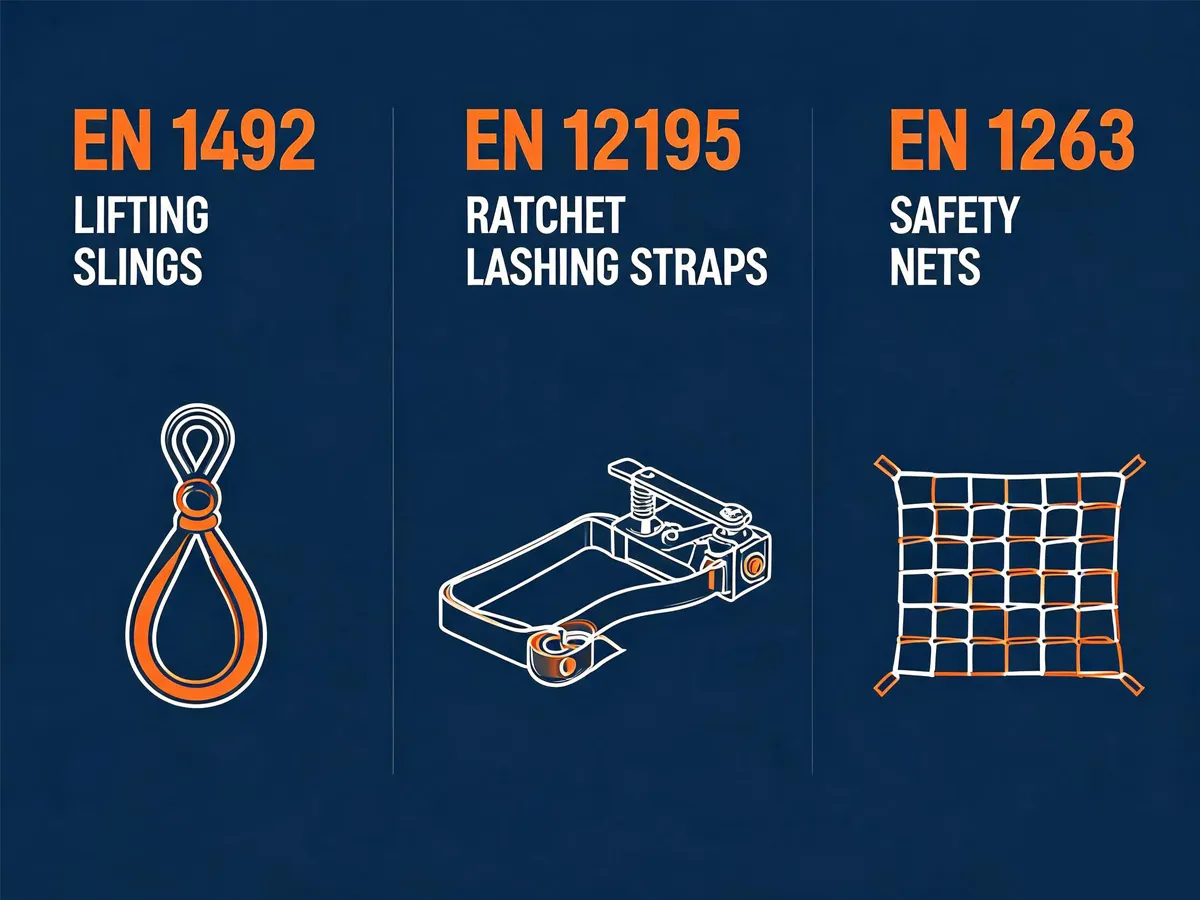
European Norm (EN) standards define the safety, testing, and labeling requirements for lifting equipment sold in the EU market. Understanding the differences between EN 1492, EN 12195, and EN 1263 is essential for procurement managers who need to verify compliance across product categories. This guide compares the three standards side by side.
EN 1492: Synthetic Lifting Slings
EN 1492 covers synthetic fiber slings used for lifting (not lashing). It is split into two parts: EN 1492-1 governs flat woven webbing slings (polyester), and EN 1492-2 governs round slings (endless and eye-eye). Key requirements: Safety factor 7:1 (MBL = 7 x WLL). Color coding by WLL (e.g., purple = 1T, green = 2T, yellow = 3T, grey = 4T, red = 5T, brown = 6T, blue = 8T, orange = 10T+). Each sling must have a durable label showing WLL, manufacturer, standard reference, manufacturing date, and batch/serial number. Proof load testing at 2x WLL during production.
EN 12195: Load Restraint (Lashing) Straps
EN 12195 covers lashing equipment for securing cargo on vehicles during transport. EN 12195-2 specifically governs woven webbing lashing straps (ratchet straps). Key differences from lifting standards: Uses Lashing Capacity (LC) instead of WLL — LC is the maximum force the strap can restrain in straight tension. Safety factor is typically 2:1 (not 7:1) because cargo securing involves restraining forces, not lifting the load. Standard tension force (STF) is also specified — the force applied by the ratchet when tensioned by hand. Color coding is not standardized (manufacturer-specific). Ratchet straps must NOT be used for lifting — the safety factor and testing protocol are fundamentally different.
EN 1263: Safety Nets
EN 1263 governs safety nets used for fall protection and debris containment. EN 1263-1 specifies product requirements; EN 1263-2 specifies installation requirements. Key requirements: Classified into System Class 1 (residential, up to 4m fall height) through System Class 4 (heavy industrial, up to 6m fall height). Mesh size: 60mm (debris containment) or 100mm (personnel). Minimum energy absorption capacity per system class (e.g., Class A2: 4.4 kJ for 100 sq.m). Border rope must have minimum breaking strength of 30 kN. UV stability and abrasion resistance testing required for outdoor service.
Side-by-Side Comparison
Purpose: EN 1492 = lifting; EN 12195 = cargo securing; EN 1263 = fall protection. Safety factor: EN 1492 = 7:1; EN 12195 = 2:1; EN 1263 = energy-based (kJ). Rating unit: EN 1492 = WLL (tonnes); EN 12195 = LC (daN); EN 1263 = energy class + mesh size. Label requirements: all three require manufacturer, date, and standard reference; EN 1492 additionally requires WLL color coding. Testing: EN 1492 = proof load 2x WLL; EN 12195 = proof load 1.25x LC; EN 1263 = energy absorption test per mesh sample.
Cross-References to Other Standards
EN 1492 slings used in multi-leg assemblies must also comply with EN 13414-1 (steel wire rope slings) or EN 1492-4 (synthetic multi-leg). Ratchet straps for road transport in Europe must additionally comply with Directive 2014/47/EU (roadworthiness testing for commercial vehicles). For North American markets, the equivalent standards are ASME B30.9 (slings), WSTDA-T-1 (web slings), WSTDA-R-1 (round slings), and AS/NZS 4380 (ratchet straps in Australasia).
Compliance Documentation
For each standard, manufacturers must provide: (1) Declaration of Conformity (DoC) referencing the EN standard. (2) Material Test Certificate (MTC) with raw material specifications and test results. (3) Type examination certificate from a notified body (for EN 1492 and EN 1263). (4) User instructions in the language of the destination country. liftrue provides full compliance documentation for all three standard families with every shipment.